This short blog was written by Amanda, initially for climate campaigners working on the economic transition, and was later published on Medium in October 2022. It offers a way to rethink the idea and “goal” of scale in our efforts to make a difference – by bringing in the paradoxical nature of public life (and building on ideas initially explored in Scaling Change – on making change big and small published in the Griffith Review.
Not long ago I was sitting in the courtyard of a pleasant city cafe in inner Sydney when a colleague from a big Australian NGO leaned over and said in a hushed but determined tone, that we needed to scale. I nodded. But looking back I wish I had brought more curiosity to the conversation. I could have asked, what did she mean by scale? Did she want more people, more change, action in more places? Did it have to be fast? Did she mean something else?
The question of how we might scale social change is a genuine mystery but it is also faddishly desired. In order to imagine how we might ‘scale’ social change we need to first take back the term ‘scale’ from the corporate startups who made it famous.
Origins
The word scale comes from the Latin word ‘scala’ meaning ladder or staircase. Scale initially referred to climbing, where something — some idea or practice — moved from a ‘lower place’ to some grander space. Geographers were the first to embrace the term. Scale was used to show how a map represented an area in ways that was true to real life. Think of a map made using a ratio of 1:100km; the map scales to represent real life, without stretching or distorting.
Bless the modern business pundits who, in the early 2000s, took the concept of scale and dare I say, scaled it. In organisational theory, and in many popular business podcasts, the word scale describes the journey from ‘small’ to ‘big.’ But somewhat ironically, at the same time that the tech startups embraced planetary scale, unbeknownst to them, geographers changed their approach to scale. Led by the brilliant Doreen Massey, geographers called for a ‘relational understanding of space’ that questioned the idea that ‘bigger’ is always more powerful. Massey said that assumptions like the idea that there is a hierarchy of scales — that global is ‘more powerful’ than the local — are myths. Her work opened a door — might the small and the local also have the power to scale?
In the early 1970s in Sydney Australia, the Builders Labourers Federation forged a series of radical alliances with working and middle class communities in defence of the environment, public housing and urban space. Jack Mundey, the leader of the union, labelled these pickets ‘Green Bans.’ Whilst the union occasionally staged Green Bans in towns and cities outside of Sydney, the Bans themselves never really travelled. But did they scale?
Petra Kelly, one of the founders of the German Green Party, visited Sydney during the Green Bans. When she returned to Germany to help establish that party, she said that she was inspired by the curious mix of urban labour-environmentalism that she witnessed in Sydney. She said it was where she got the idea to name her party the ‘Greens.’
This is just one example, but it shows how scale — when applied to social change — is very different to scale in the corporate world. Corporate scale is about ownership and spread, reduced to questions of monetary value. Facebook or Apple scale when their brand, products and channels dominate the markets in which they work, drawing a commensurate profit. Even when big corporate players note the importance of smallness, as AirBnB does in its origin story, scale is still measured by how the company spread around the world.
Social change is different. While social change is sometimes energised by the might of a big personality or a powerful organisation, emancipatory change is a beast of the masses, activated by social forces much bigger than any corporate player. In social change the question of scale is far more complicated and interesting because it is about understanding how something can morph and spread — like from Sydney to Germany — when the ‘thing’ is not under anyone’s control.
Scaling Social Change
When we invoke the idea of scale and apply it to social change — what are we trying to actually scale? Scale is usually applied to one or all of these ideas:
- What we want: the claims and issues we seek to change
- Where do we seek the change: the places in which we work and hope to influence
- How we do it: the methods we use to enact that change in those places
Scale is most commonly connected to the need to scale our issues and demands, the substance of social change. Scaling an issue is particularly profound in recognition movements, like feminism, civil rights, LGBTIQ+ — where specific demands like equal pay, the right to vote or the right to marry became beachhead claims. These demands slowly ‘scaled’ as movements grew, drawing in sufficient community support creating pressure for political action across states and nations.
But every issue is located. Social change is fought in defined places and a local battle is different to a national one. The scale of these battles shapes the issues that are contested and how people get involved. For example I might work with my kids’ school to help it go carbon neutral, and I also might join a national climate organisation to be part of a federal election campaign. While it will be pretty easy for me to have a deep sense of ownership and leadership in the school campaign, the national nature of the election campaign will likely make me far more distant from the strategy, more of a participant than a leader. On the other hand, I might feel more invested in the scale of an election because it could change the country, whereas solar panels on my kid’s school could feel like a drop in the ocean. Geography helps us see more clearly the perennial, unresolvable tension in social change between the need to build powerful movements that are both rich with ‘participation and leadership’ (people’s autonomy) and the need to ‘coordinate’ and connect those participatory movements across multiple sites and scales in order to achieve wider impact (this idea is unpacked in the book Power in Coalition, the relevant chapter is here).
Finally, people ‘do’ social change differently, and these different approaches scale differently too. Mobilising magnificent protests, like the Student Strike for Climate, that rapidly and reactively draw people to action create tremendous scale if we define scale as both big and fast. In contrast, organising is painstaking, slowly engaging people one-to-one. Organising isn’t fast, but it does bring its own form of power. Take the Industrial Areas Foundation. From its beginnings in Chicago 80 years ago, it now flourishes in 98 cities around the world. Its translocalism offers its own kind of scale, without the trappings (or media attention) that comes from a big protest.
Rethinking Scale
There is no one path to scale social change, and that’s a gift. But right now we are unsure about how to think about what these different paths to scale might look like. We don’t have a lot of tools or concepts to help us. Too often we end up just throwing it all up against the wall to see what sticks.
In the interests of sparking a discussion — here are some tools and concepts to consider.
Scale is connected to ideas of ‘bigness’ but it is also about ‘speed.’
When social change campaigners talk about (or lament a lack of) scale they often conflate two ideas — scale is frequently seen as something that is big and something that happens fast. In doing so the concept of scale (which is traditionally about geography and place) is linked to the idea of time. There is nothing wrong with this, indeed, it makes scale easier to see. Drawing out the distinctions between what it means to be big or small versus what it means to be fast or slow sheds new light (and some new tools) that can help us understand distinct pathways to scale.
I use the table below to break this down. Rather than assuming that social change scales only when it is ‘fast’ and ‘big,’ the table identifies a range of different ways that issues, place and method can produce powerful ‘scalable’ change.
Table: Scale as big-small & fast-slow
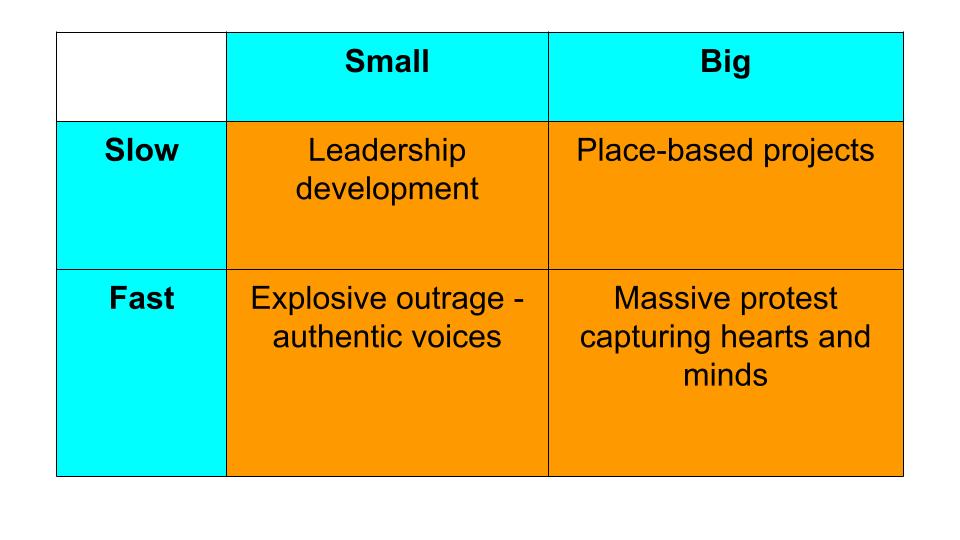
We are familiar with the big/fast box. That’s where rapid change seems to come out of nowhere. It’s where an issue taps into the energy of others and protests erupt. The Student Strikers, the movement against the war in Iraq, Women for Justice, even the formation of GetUp played out these mobilising dynamics. This kind of escalation has a distinctive energy, but at the same time people who’ve been involved in these kinds of moments always emphasise that these escalations tap into long standing networks and leaders. Social change is rarely ever that fast.
Then, there is small/fast. Most community organisation and union campaigns rise and fall in this box. When it works, small/fast is a space for experimentation and creativity. The best small/fast campaigns take a specific battle and turn it into the whole fight, like when Emma Gonzalez, David Hogg and countless others from Parkland Florida turned their experience of surviving a school shooting into a broader battle around gun violence (see this ChangeMakers podcast for more). That said, there are plenty of issues energised by outrage that launch into public life, few scale. Many small/fast movements break the cardinal rule of scale and try to stretch instead. Like any good map, a movement isn’t scaled if it distorts real life. When an ‘air war’ substitutes for ‘ground war,’ when social media engagement replaces genuine relationship building, when campaign metrics don’t add up to something meaningful, when your people are your audience and not the source of your power, when a lack of day-to-day evaluation leads to a lack of creativity — then small/fast is stretching not scaling.
‘Slow’ can help us re-imagining scale.
The combination of slow and small is often dismissed, but it frequently underpins all of the other forms of scale. Change is made by leaders acting together, but none of us are born with the skills or knowledge that we need to create that change. We learn to lead when things are small and slow. Of course organising a ‘big’ protest invites you to do new things, but reflecting on what went well and how you might improve allows you to grow as a political actor. Slow and small can be anything from a one-to-one meeting to education and training, from mentoring to reading, from evaluations to sabbaticals. Training for instance, is the central ingredient of the 98 Industrial Areas Foundation urban alliances as well as Jane McAlevey’s approach to scaling union organising strategies.
Slow and big is possible. The Green Bans exemplified this, but you can see it in any long term campaign that prefigures an issue or demand much bigger than itself. The Franklin Dam became an emblematic the battle for nature. The 2014 Bentley Blockade in the Northern Rivers was a similar reckoning over land and gas (for more here). Each of these campaigns slowly built deep local relationships over years without any attention, led by people with decades of experience. Slow/big movements scale because their targeted ‘slowness’ builds an intimate connection to a place while speaking about a ‘big’ change narrative that can set off dominoes in other places.
At their peak, slow/big movements explode into bigness like fast moments, but how they get there is very different. These movements enact Massey’s idea that ‘scale’ always mean ‘planetary.’ Sites of slow/big movements are very intentional — chosen by locals and supporters — and selected because they are emblematic of bigger fights. To scale, ‘slow’ requires an enormous investment. Rather than stretching resources, this approach concentrates support because the leaders in these strategic places will be the people who not only create a story of change for their campaign, but they will play a role in teaching leaders in other places how to win. Coalition building and alliances are central — alliances are built in place (workers and residents for the Green Bans, farmers and environmentalists in the Northern Rivers), and multi-scaled networks are also built to generate external support. But every time, the generative power of the bigness comes from the slowly built local relationships in a specific place. For this kind of scale — less is more.
Takeaways
The corporate world popularised the term scale but in doing so it simplified it to ideas of bigness. That doesn’t serve people seeking social change. We need an approach that can plainly and easily recognise that there are different ways to scale, and provide a road map that can help us see the different ingredients that might go into these alternative paths. Undoubtedly a social change approach to scale is more ‘complex’ than this grid implies. But my aim is to stimulate new thinking about the many ways that we can scale change — so we might scale some more of the change that we need.
This approach to scale offers new language that might help us label and differentiate a suite of different approaches to scaling social change.
To make it practical and to open debate:
- Scaling ‘place-based projects’ isn’t about working locally everywhere but instead thinking about ‘big’ investments in 6 or 10 sites over at least 5 years. We are reminded that when building these projects we need to find a powerful group of local leaders who are able to mentor and model change elsewhere
- Big/fast — this will happen again — how do people focused on localism and place-based work connect with these moments? How can we harness the opportunity of a big/fast movement (for a discussion see La PAH’s strategy in Barcelona re the Indignados here)
- Small/fast — how can moments of activity be connected to longer term strategy, where people are provided with tools for self-organising to sustain capacity.
- Small/Slow — what is the culture that we are building between us? How do we foster leadership development in our national teams/groups and in our place-based projects? What are we building small and slow to help us scale?