Action and Reflection
Action makes a difference; reflection makes meaning and sharpens what happens next.
On this page:
|
|
|
|
|
|

The paradox
Making a difference requires both action and reflection. Action is how we make a difference with others in public life — by putting pressure on decision-makers to provoke a response. Reflection is how we make sense of what action does: what it changes or fails to change, what it reveals about us, and what it asks of us from here.
Action and reflection are not opposites, but connected practices. Action sets things in motion; reflection interprets what follows. Action is visible, urgent and time-bound. Reflection is slower, quieter and more interpretive. Both are relational. Action draws others into response, while reflection — even when we do it alone — is shaped by our relationships and experiences.
Held together, action and reflection allow tribes to change the world while changing themselves in the process.
The shape of the paradox:
Action and reflection continually shape and strengthen each other

What needs rethinking?
Rethinking this paradox starts with revaluing reflection as part of action, not a pause from it. Reflection helps us make sense of what happened, learn from it, and consider what needs to change.
Action does not only change public life; it can also change us and strengthen our tribes. It can build confidence, deepen relationships, develop leadership and clarify purpose. Plans help us act with intention, but public life is always changing and no action can be fully controlled. Reflection keeps us alive to what we did not anticipate, what is emerging, and what planning alone would miss.
We often value action because it is visible, urgent and public. It looks like leadership and momentum, especially when something is wrong and needs to change. But when action becomes the only thing we recognise, tribes can keep repeating familiar tactics without asking what they are learning, or whether those tactics are still working.
This bias also shapes how we judge action, measuring effectiveness only by visible external results: decisions won, media attention, or shifts in public debate. These outcomes matter. But if they become the only measure, we can underrate smaller forms of action — meetings, negotiations, testimonies or rehearsals — that move people towards a larger goal. We can also miss another measure of successful action: whether it strengthens our tribes.
Public action and reflective thinking are different practices, but both are diminished when they are disconnected. Reflection without action can dissolve into analysis with no public consequence. Action without reflection can lead to blind repetition, where tribes keep using the same tactics without learning from what is happening. When we separate them, reflection gets pushed to the margins: after the action is finished, after the campaign is over, or onto the agenda of a dedicated retreat — missing the learning and adaptation that reflection can bring to action while it is still unfolding.
Connections across the map

Big and small
Action can reach for bigger change; reflection sharpens action by learning from the smaller relationships and preparation that make change possible.

Public and private
Action responds to public pressures; reflection helps us understand how those pressures shape private life and personal agency.

Us and Others
Action gives a tribe life and purpose; reflection helps it learn, adapt and act more powerfully with others.

Power Over and Power With
Action uses power to provoke a reaction; reflection helps keep that power accountable and connected to relationship.

Curiosity and Judgement
Judgement helps us decide when, where and how to act; reflection keeps us curious about what happened, what surprised us and what can be learned.

Sameness and Difference
Action needs enough sameness to bring people together; reflection makes space to recognise difference and ask what has been missed.
Acting consciously
Action and reflection are always in flux, which means tribes need to keep noticing how they are holding the tension between them. Too much action can lead to exhaustion, repetition and missed opportunities to learn. Too much reflection can lead to paralysis, abstraction and no impact. The task is not to find a perfect balance, but to keep adjusting — knowing when to act, when to pause, and how to keep each connected to the other.
Acting consciously means paying attention to several things at once: what an action is trying to change in public life, what it is doing inside our tribes, and what it reveals that we did not expect.
Actions are designed to generate a response in public life. We ask: who needs to react, what story do we want to tell, and how will this action build power as well as apply pressure? But we also need to ask what the action is doing among the people taking part. Is it strengthening relationships, connecting people with one another, developing leadership, or expanding their sense of what is possible? Held together, these questions help us see how action can change the world and change us at the same time.
Reflection is not something to save for later. It can be woven into our own, and our tribe’s, everyday practice. We do not need to wait for a retreat, or only reflect on big public actions. There is plenty to learn from smaller moments: meetings, negotiations, one-to-one conversations, and the everyday interactions that shape how a tribe works.
Evaluation does not need to be complicated. Simple debriefing questions like “what worked?” and “what would I change?” can make space for people to interpret what happened. When a tribe has a habit of reflection, people’s leadership can grow as they digest what they experienced through acting together. Each of us can build that habit through mentors, regular peer conversations, or journaling.
Everyday reflection does not replace deeper periods of stepping back. Retreats, sabbaticals and time away from immediate pressure have an important role. But they do not substitute for the everyday reflection that keeps learning close to action, helping tribes adjust and grow as they go.
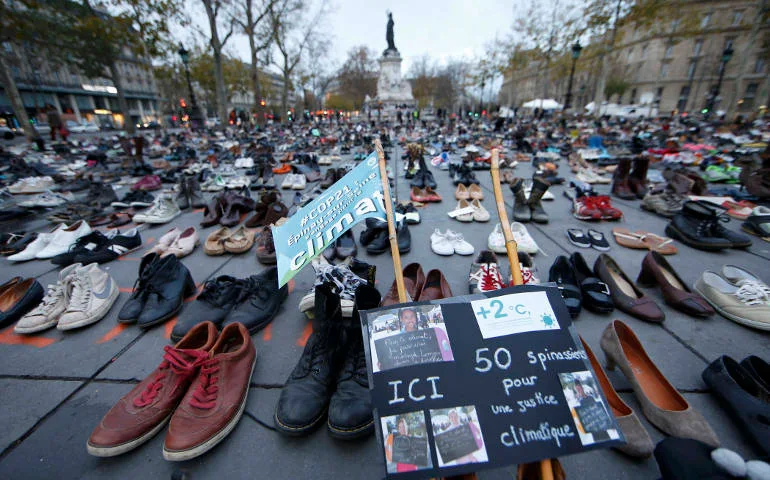
The Shoes at Place de la République
The COP21 protest story in Chapter 8 shows how reflection can make a different kind of action possible.
Questions to sit with
Sitting in the tension
- When you face a pressure or problem in public life, do you tend to reach first for action or reflection?
- How does the idea that action should generate a reaction change how you think about public action?
- When have you seen action become repetitive? What stopped people from pausing, learning or adapting?
- What becomes possible when reflection is treated as part of action, rather than something that happens afterwards?
Navigating action and reflection in your practice
- Where does the connection between action and reflection break down for you or your tribe?
- What helps you move between the two more consciously?
- Where do you currently make space for reflection — in your own time, with others and with your tribe — and how could you be more intentional about it?
- Can you think of a time when action changed not only the situation you were trying to shift, but also you or your tribe?
- What everyday habits would help your tribe learn more consciously from what it does?
From the book
Noble intentions alone do not make a difference; change demands action in public life. When we act, we use our power to compel decision-makers to respond to the challenges we face. Reflection plays a different role. It forces us to confront who we are and how we have acted so we can reimagine and strengthen what we do next. Reflection is not the opposite of action; it is how we learn to act more effectively.
Reflection can connect what we do to why we care about it. It helps us recognise what makes us different; it clarifies our strengths and limits, helps us harness our gifts and resists the pull of thoughtless conformity. It renews our relationship with ourselves. In these ways, reflection unsettles the goals of action. By recognising that action is a source of learning as well as a way to effect change ‘out there’ in public life, reflection reminds us that to change the world, we must also change ourselves.
Putting it into practice
Practice to go here
Practice to go here